
Lightning Protection Guidelines for Ecowitt Wireless Weather StationsUpdated 6 months ago
1. Scope and Protection Philosophy
Ecowitt wireless weather stations feature a cable-free outdoor design. Since no AC power lines or Ethernet cables connect the outdoor unit, lightning risk is primarily associated with direct strikes, side-flashing, induced surges, and electrostatic charge accumulation. This document provides engineering recommendations to reduce these risks.
2. Direct Strike Protection (Air Terminal Method)
To shield environmental sensors, a passive air terminal (lightning rod) should be integrated into the mounting structure.
2.1 Protection Zone and 45° Rule
! According to simplified rolling sphere or cone protection concepts, the sensor must remain within the protected zone created by the air terminal.
- The 45° Coverage Principle: The protection zone is defined by a 45° angle extending downwards from the tip of the air terminal.
- Dynamic Placement Logic
· Fixed Rod Height: If the height of the air terminal is predetermined, the sensor must be moved horizontally closer to the mast to ensure it sits within the 45° protection cone.
· Fixed Sensor Position: If the sensor's mounting location cannot be moved, the vertical height of the air terminal must be increased until the 45° slope extends far enough to fully cover the sensor housing. - Vertical Clearance (h): The air terminal must extend above the highest point of the sensor by a height h. This value h is the critical reference for calculating the horizontal protection radius (at a 45°angle, the protection radius at the sensor's level is equal to h).
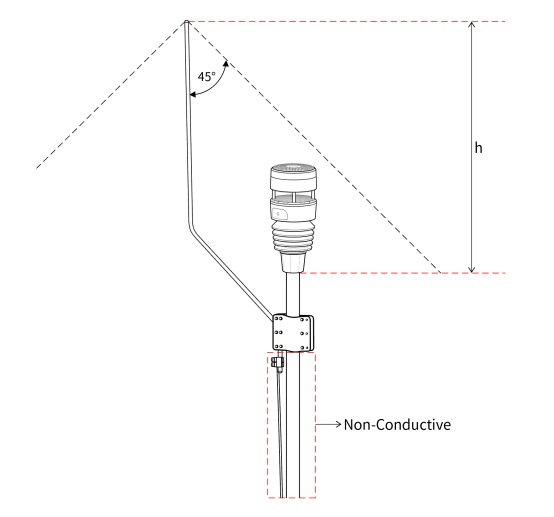
Figure 1
2.2 Separation Distance
Maintain horizontal clearance from tall objects like trees.
- Clearance Formula: Recommended clearance ≥ 10 × h (where h is the vertical height difference between the rod tip and surrounding highest object).
- Purpose: This reduces side-flashing risk and turbulent airflow interference.
2.3 Compliance Requirement
Any air terminal system must be installed in accordance with applicable local lightning protection standards, such as:
- IEC 62305 (International)
- NFPA 780 (United States)
- Applicable national or regional electrical codes
Improperly installed lightning rods may increase risk rather than reduce it.
3. Structural Isolation (Insulation Requirement)
For proper protection, the mounting structure must prevent lightning current from passing through the sensor chassis.
- Non-Conductive Upper Section: Use a UV-stabilized PVC or fiberglass extension pole for the upper section (approximately 0.5 m) and horizontal arm supporting the sensor.
- Material Restriction: These components must be made of insulating materials and cannot use conductive metal to ensure the sensor is electrically isolated from the primary dissipation path.
4. Grounding and Dissipation Path
A low-resistance path to earth is essential to safely dissipate intercepted lightning current.
- Conductor Specification: Use a minimum 10 AWG copper conductor (≈ 5.3 mm²). An 8 AWG conductor (≈ 8.4 mm²) is recommended for high-exposure areas.
- Grounding Electrode: Connect the conductor to a grounding electrode system compliant with local codes, such as a 2.4 m (8 ft) copper-clad steel rod.
- Bonded Lower Mast: The lower metal mast section should be the bonded and grounded portion, allowing for charge dissipation without affecting the isolated sensor.
- External Routing: The grounding conductor should be routed externally along the structure. Avoid routing through interior walls to prevent induced currents in household wiring.
5. Maintenance Checklist
Regular inspection improves long-term reliability.
Recommended annual inspection:
- Check ground clamps for corrosion or loosening
- Verify conductor continuity and inspect bonding points for oxidation.
- Ensure mounting hardware remains secure
- Confirm grounding conductor insulation integrity
If feasible, periodic ground resistance testing is recommended in high-risk lightning regions.
6. Important Disclaimer
Ecowitt weather stations are not certified lightning protection systems. These guidelines are general recommendations and do not guarantee immunity from damage. Installation must comply with local electrical codes.