
WQT01 Daily Water Quality Report-2026-10-15Updated a minute ago
2026-10-15 | Freshwater planted aquarium | Prototype trial
This report records aquarium maintenance, observations, and the engineer’s interpretation of the day’s water-quality trends. The engineer classified the daily status as gradually increasing.
Daily record
Maintenance: Fertilizer and water conditioner were added. No top-up, glass cleaning or algae removal, trimming of decaying leaves, removal of dead leaves, substrate vacuuming, water change, filter floss cleaning, or filter media cleaning was marked.
Feeding: Normal feeding was selected; reduced feeding and no feeding were not selected.
Observation: Persistent black, hair-like algae were present in the aquarium.
Recorded trends
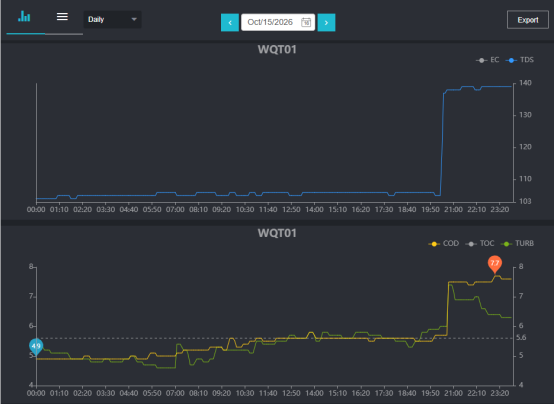
Original chart retained for reference.
Engineer analysis
TDS — Total dissolved solids
Fish and shrimp waste and decomposing uneaten food continuously release dissolved salts, while the substrate slowly releases minerals. Adding GH and KH supplements, NPK fertilizer, iron fertilizer, and trace elements together in a single batch introduces a relatively large quantity of inorganic salts. TDS showed a clear step increase beyond its normal daily fluctuation range. A sudden change in osmotic pressure can stress aquatic organisms. With small daily doses of fertilizer, TDS changes remain within the daily fluctuation range, with no clearly observable change. Ion uptake by aquatic plants can offset most ion inputs, leaving only limited accumulation; readings rise slightly while the overall baseline remains stable.
COD — Chemical oxygen demand
During the unlit nighttime period, organic matter release and microbial degradation were approximately balanced, and COD remained stable. Following this batch addition of multiple fertilizers, COD showed a clear step increase. It is not yet possible to determine whether this increase came from organic chelating agents or organic solvents in the formulations. The planned follow-up is to dose each additive separately to identify the specific cause. After the lights came on, environmental conditions changed and the rate of organic matter release increased. More organic substrate also increased microbial degradation, but release accelerated faster and gradually exceeded consumption, causing organic carbon to accumulate before reaching a daytime plateau. Later in the daytime period, readily soluble organic matter available for rapid release from the substrate surface was largely depleted, and the release rate declined. Organic matter release from the substrate and microbial degradation then maintained a dynamic balance, with COD remaining at an elevated plateau.
TURB — Turbidity
At night, with no new particle inputs, suspended debris continued to settle and be captured by filtration, gradually reducing turbidity. Batch fertilizer dosing or the addition of KH powder can cause a step increase in turbidity through substrate disturbance by liquid flow, colloidal fertilizer particles, and undissolved powder. When the lights came on in the morning, water warming and increased biological activity caused persistent, slight resuspension of fine particles from the substrate surface, producing a sawtooth pattern during the day.
Recommended adjustments
Avoid adding multiple conditioners and fertilizers together in a single large batch where possible, to reduce organism stress from abrupt TDS changes. Feed according to need, change water regularly, and remove accumulated substrate debris when necessary. Monitor the effects of additives on COD and turbidity, prioritize small divided doses, and dose fertilizers separately in subsequent tests to investigate the source of the COD increase.
Daily status: Gradually increasing. Stable, threshold warning, and danger alert were not selected.